Table Of Content: General: 1.1 Basic information Control of tool building progress Packaging and transportation Product Responsibility Flow diagram 1.2 Documents Drawings / CAD-files Moldflow report Preliminary Tool Drawings Final Tool drawings Progress reports Trial reports Cooling plan Hot-runner plan Hydraulic plan Checklist A General Technical Information: Tool Construction Tool base design Steel quality and Heat Treatment Screw bolds Tool centring and Tool Clamping Inter Locks Hoisting holes and lifting bolts Hoisting blocks Isolating plates Lubrication and cavity protection Date stamps and recycling inserts Painting Tool marking Cavity and Core Cavity/Core Marking Texture Coatings Cooling-connectors principles Venting O-rings Guiding Welding in Cavity and Core Shrinkage allowance Hot-runner Hot-runner Suppliers Principle of Hot-runner systems Principle of wire connections Heating central nozzle Cams and Slides Ejection Dismantling of Tool Spare Parts Switches Remarks General: 1.1...
此博客中的热门博文
How to deal with transparent injection molding
How to deal with transparent plastic material PMMA,PC and PET injection molding Due to their high light transmittance, the requirement for transparent plastic surface need to be strict, it can not has any markings, voids, whitening, black spots, discoloration, poor gloss and other defects. Thus the whole injection molding process for raw materials, equipment, molds, and even product design, could be said very strict and sometimes even very special. Further more, because of most transparent plastic with high melting point, poor mobility, to ensure the surface quality of the products, it often needs make minor adjustments at high temperature, injection pressure, injection speed and other parameters, so that it could both fill plastic injection mold properly and will produce proper stress which would cause no deformation and cracking. How to dry the raw material Due to any impurities in plastics, they may affect the transparency of the product .Therefore on storage, tran...
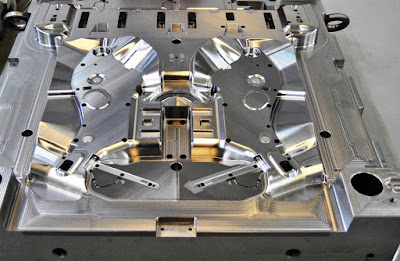
plastic mold machines Hourly Rates Dipped
plastic mold machines Hourly Rates Dipped Custom injection molders’ machine-hour rates dipped 1.3% on average in the second quarter of the year, according to 122 plants responding to our latest semi-annual survey. Rates have been dropping since the end of 2000. About 12% of respondents said their rates were lower in the second quarter than in the quarter before. Only 5% raised rates, and 83% did not change them at all. However, there were some signs that business was turning the corner at midyear. Molders’ average machine capacity utilization rose about 1.5 percentage points to 53%—still very low by historical standards. Almost 40% of respondents said their capacity utilization increased in the second quarter, versus 31% whose utilization was lower and 29% whose utilization was unchanged. This was the first time since early 2000 that more shops were gaining business than were losing it. Southeastern molders again enjoyed the highest capacity utilization, while those in the West had th...
评论